
The Impact of Google’s AI Overviews on SEO
June 8, 2024
The Future of Search: How Generative AI Is Changing SEO
September 2, 2025
SEO is no longer just about ranking on Google. With the rise of ChatGPT, Gemini, and Perplexity, millions of users now turn to AI-powered engines that deliver direct answers instead of traditional search results. This shift has created a new challenge for marketers: how do you ensure your content is included and cited within those AI-generated answers?
That is where Generative Engine Optimization (GEO) comes in. First introduced in a 2023 research study from Princeton and Georgia Tech, GEO is the practice of making content machine-readable, authoritative, and citation-ready so generative engines can retrieve and trust it.
You may also see it referred to as Answer Engine Optimization (AEO) or Large Language Model Optimization (LLMO). While the terminology differs, the core principle is the same: optimizing content so it can be discovered, interpreted, and cited by AI-driven engines.
In this article, we’ll unpack GEO in detail. You’ll learn what it is, why it matters, how AI search engines work, the principles of optimizing for them, a practical framework you can apply, and the tools you need to stay competitive.
TL;DR
- GEO defined: Generative Engine Optimization (GEO), short for Generative Engine Optimization (aka AEO or LLMO), is the practice of making your content machine-readable, authoritative, and citation-ready so AI-powered engines like ChatGPT, Gemini, and Perplexity can retrieve and reference it.
- Why it matters: ChatGPT surpassed 400 million weekly active users in 2025. Perplexity logged over 700 million queries in a single month. Google’s AI Overviews are live, reducing organic CTR by as much as 70%.
- How to adapt: Continue strong SEO fundamentals, but add GEO layers such as structured data, clear answer sections, FAQs, topical clusters, and citation of authoritative sources.
- Tools to use: Perplexity Pro (for testing visibility), Rank Math (schema and on-page optimization), InLinks (entity-based optimization and internal linking), Semrush AI SEO Toolkit (prompt tracking and AI site audit), and Ahrefs (backlink analysis and competitor research).
What is Generative Engine Optimization?
GEO is about getting your content into AI-generated answers. Traditional SEO optimizes for SERPs. GEO optimizes for engines that synthesize information.
The original 2023 study that coined the term showed how structural tweaks such as adding citations, quotations, and schema increased the likelihood of being referenced by AI tools.
Think of it this way: SEO is about climbing search rankings. GEO is about being chosen as a trustworthy building block when AI generates an answer.
For example, if a user asks ChatGPT: “What are the best standing desks for home offices?” ChatGPT generates a direct answer mentioning a few popular products and citing review sites or buying guides.
If your eCommerce brand has a GEO-optimized comparison page with updated pricing tables, FAQs, and structured product data, it has a chance to be cited as part of that answer. Without GEO, you risk being invisible even if your store ranks on Google.
Why GEO Matters Now
ChatGPT changed the landscape
When ChatGPT launched with browsing capabilities, it marked the first time users could get full answers without touching Google. By 2025, it had 400 million weekly active users. That is mainstream adoption at lightning speed.
Google’s AI Overviews are live
Google rolled out AI Overviews in 2024. These appear at the top of SERPs and often satisfy search intent without a single click.
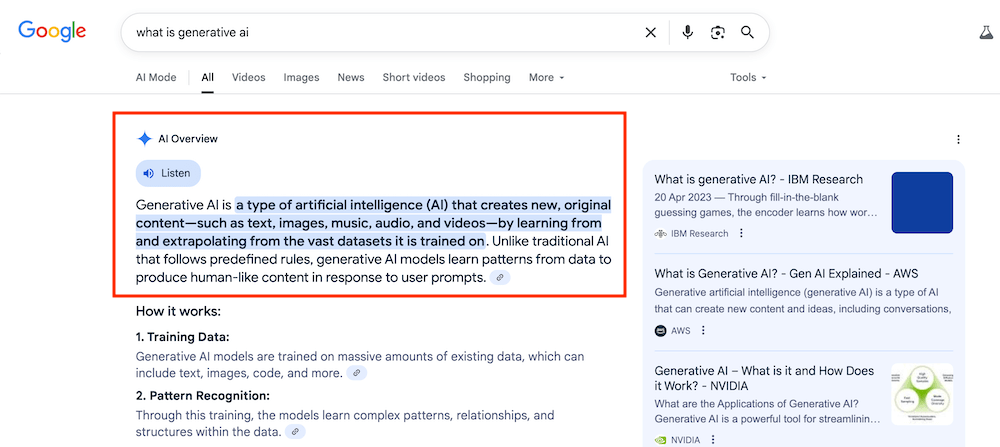
Studies report that click-through rates drop by 30–70% when overviews are present.
Perplexity shows the power of citations
Perplexity AI has become the first popular engine to make citations a feature.
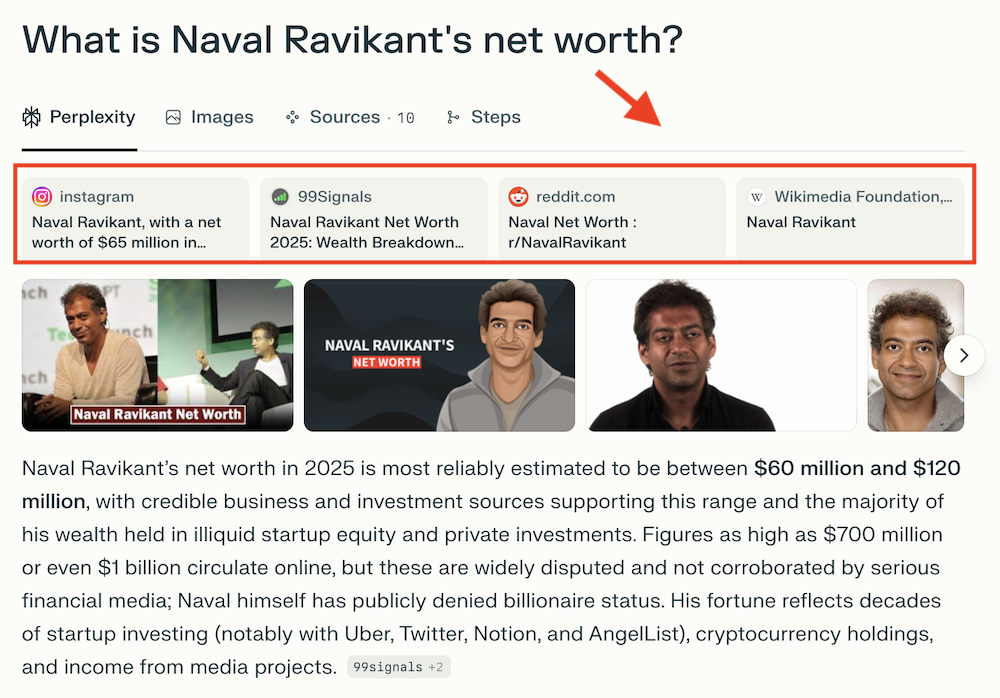
In July 2025, it reported 780 million monthly queries. For marketers, this means GEO can translate into measurable referral traffic.
AI is eating search traffic
The Wall Street Journal reports that generative AI search tools like ChatGPT and Perplexity accounted for approximately 5.6 percent of U.S. desktop search traffic in June 2025, more than double the share from a year earlier. If your content is not citation-ready, it risks being invisible in the channels where users are increasingly searching.
How Generative Engines Work
Generative engines like ChatGPT and Perplexity operate in two stages:
- Retrieval: The system fetches relevant documents from the web or proprietary datasets.
- Synthesis: The AI model generates an answer, blending retrieved content with its own knowledge.
Some engines provide transparent citations (Perplexity), while others are inconsistent (Gemini often answers without attribution). This makes it critical for your content to be easy to parse, well-structured, and authoritative.
If an AI system considers your page “messy” or low-trust, it may use your information without credit.
GEO vs SEO: What’s the Difference?
Search Engine Optimization (SEO) and Generative Engine Optimization (GEO) are closely related, but they are not the same.
Traditional SEO focuses on ranking content in search engine results pages, while GEO focuses on being cited within AI-generated answers. Both rely on authority, clarity, and trust signals, but the way they surface content is different.
The table below highlights the key distinctions:
| Factor | SEO Focus | GEO Focus |
|---|---|---|
| Goal | Rank on SERPs | Be cited in AI-generated answers |
| Key Signals | Keywords, backlinks, technical SEO | Clarity, structure, authority, trustworthiness |
| Measurement | Rankings, traffic, impressions, CTR | Citation frequency, AI referrals, brand visibility |
| Optimization Style | Human intent + crawler friendliness | Human readability + machine readability |
Core Principles of GEO
Generative Engine Optimization is not a single tactic but a layered approach that blends technical SEO with content strategy. To succeed, you need to understand the fundamentals that make content visible and citable to generative engines.
The following five principles form the foundation of any effective GEO strategy:
1. Write for clarity and citation
AI engines favor concise, structured content. Add a TL;DR or summary box at the top of posts, define terms in plain language, and include FAQs.
For example, let’s say you run a SaaS company that offers payroll automation. A prospect asks ChatGPT: “What are the best payroll software options for small businesses?”
If your comparison page opens with a clear summary box that lists the top three solutions, including your own product, along with a one-line explanation of each, ChatGPT is more likely to extract and cite that information.
2. Use structured data
Schema markup makes your content machine-readable. Add FAQ schema to Q&A sections, HowTo schema to tutorials, and Product schema to reviews.
Tools like Rank Math allow you to add and manage these schema types directly within WordPress, without custom coding.
Once implemented, use Google’s Rich Results Test to validate that your markup is error-free and visible to search engines as well as generative AI systems.
3. Build topical authority
Generative engines prefer authoritative domains. Build clusters around key topics and connect them with internal links.
For example, if you run an eCommerce brand that sells eco-friendly products, you could create a cluster around sustainable living: a buying guide for eco-friendly household items, individual product reviews, a comparison of popular sustainable brands, and an FAQ on certifications like Fair Trade or USDA Organic.
Linking these together signals topical depth and makes your site more likely to be cited in generative search answers.
4. Showcase trust signals
Add detailed author bios, cite your sources, and keep your references updated.
GEO research shows that pages citing external sources were significantly more likely to be used in generative answers.
A simple habit like linking to original data studies can boost your credibility.
5. Maintain backlink health
Authoritative backlinks remain vital. Use Semrush or Ahrefs to track your backlink profile and pursue links from trusted sites. If your content lacks authority, AI engines may prefer competitors’ pages even if yours is more relevant.
A Practical GEO Framework
Here’s how you can approach Generative Engine Optimization (GEO) step by step. Each part of this framework reflects the core areas covered in our GEO Accelerator Plans.
1. Audit your content
The foundation of GEO is knowing whether your content is being picked up by generative engines today. Run a set of prompts in ChatGPT, Perplexity, and Google SGE, then analyze whether your pages are cited or ignored. Look closely at the competitors that are being cited: what formats, structures, and signals are they using?
Tools to use: ChatGPT and Perplexity Pro for prompt testing, Semrush AI SEO Toolkit to benchmark AI visibility.
2. Add answer-first sections
AI engines prefer content that delivers answers upfront. That means TL;DR summaries, FAQs, and definition blocks near the top of your page. This structure makes it easier for ChatGPT and Perplexity to pull excerpts while still encouraging human readers to scroll deeper.
Tools to use: Rank Math for FAQ and schema markup, Semrush AI SEO Toolkit for content audits.
3. Apply structured markup
Schema is the machine-readable layer that helps generative engines parse your content. FAQ, Product, HowTo, and Article schema should be systematically applied across your priority pages. This is not a “nice to have” anymore. Without it, your content may be invisible to AI systems even if it ranks in Google.
Tools to use: Rank Math for schema, InLinks for entity-based optimization.
4. Refresh and expand content
Generative engines reward freshness. If your statistics, pricing, or product details are outdated, there’s a strong chance they’ll ignore your page in favor of a more recent competitor. Establish a cadence of updating key posts and expanding thin content into comprehensive resources.
Tools to use: Semrush AI SEO Toolkit to flag outdated data, Ahrefs to identify gaps competitors have already covered.
5. Strengthen clusters
Authority in generative search doesn’t come from isolated posts. It comes from clusters, meaning multiple interlinked assets that cover a subject from different angles. A SaaS brand competing for “compliance software” should publish product comparisons, buyer’s guides, FAQs, and supporting explainers, all connected through a clear internal link structure.
Tools to use: InLinks for semantic clustering, Ahrefs for competitor cluster mapping and backlink opportunities.
6. Track AI visibility
Traditional SEO metrics no longer tell the full story. To measure GEO impact, track prompt-level testing across platforms, monitor citation frequency, and review referral traffic from engines like Perplexity. Over time, this shows whether your optimization efforts are producing tangible visibility.
Tools to use: Perplexity Pro and ChatGPT for prompt tracking, Semrush AI SEO Toolkit for visibility reporting.
7. Create and Optimize an llms.txt file
Generative engines often struggle to parse websites filled with navigation menus, pop-ups, and hundreds of blog posts. An llms.txt file acts as a simple AI-friendly roadmap that highlights your most important URLs. It works like a sitemap but is designed specifically for large language models.
By curating 15 to 30 cornerstone pages such as your best guides, product pages, and case studies, you increase the likelihood that engines like ChatGPT and Perplexity will ingest and cite the right content.
Tools to use: Any plain text editor. Save the file as llms.txt in your site’s root directory, the same place as robots.txt. Update it quarterly as you add new cornerstone content or retire older pieces.
GEO: Challenges and Limitations
GEO is still in its early days. The opportunity is real, but it comes with limitations that marketers and business leaders need to be aware of.
Understanding these challenges helps set the right expectations and ensures you treat GEO as an evolving discipline rather than a silver bullet.
- Opaque algorithms: Generative engines do not disclose exactly how they retrieve and rank content. This makes GEO partly experimental, requiring testing across multiple platforms and monitoring which content surfaces.
- Inconsistent attribution: Some engines, such as Perplexity, include citations in most answers, while others, like Gemini, often do not. This means your content may be used to generate responses without your brand being credited.
- Fast evolution: GEO best practices are still forming. What works today, such as adding FAQs or schema, may need to be adjusted in six months as AI systems evolve. Businesses must be prepared for ongoing adaptation.
- Referral unpredictability: Even when your site is cited, the resulting traffic can be inconsistent. Unlike traditional SEO, where rankings correlate more directly with clicks, GEO visibility does not always translate to steady referral volumes. Monitoring and iteration are essential to extract meaningful results.
The Future of GEO
Generative search is not going away. Expect three trends to shape the next two years:
Deeper integration with Google and Bing
AI answers are moving from side experiments into the core search experience. Google’s AI Overviews and Bing’s Copilot integrations show that generative answers will sit above traditional results more often, cutting into organic clicks. Businesses that only optimize for traditional SEO risk losing visibility as these integrations expand.
Growth of GEO analytics platforms
Today, prompt testing and citation tracking still require manual work across ChatGPT, Perplexity, and other engines. In the coming years, we can expect dedicated GEO analytics tools that measure citations, referral traffic, and even prompt-level performance. These will make it easier to treat GEO with the same rigor that SEO analytics enjoy today.
Rising competition for citation spots
Just as SEO became more competitive when businesses realized the value of ranking on page one, GEO will face the same trajectory. Once companies understand the visibility advantage of being cited in generative answers, entire industries will compete for those few reference slots. Early adopters will have a significant advantage, while late movers will find it harder to break through.
Early adopters who treat GEO seriously now will not only gain visibility but also establish authority signals that generative engines will continue to recognize over time. That compounding advantage will be difficult for competitors to catch up with later.
Final Thoughts
Generative Engine Optimization is the natural evolution of search marketing in the AI era. SEO fundamentals still matter, but they are no longer enough. GEO ensures your content is discoverable and cited when AI engines generate answers.
If you publish with clarity, structure, topical depth, and trust signals, and reinforce it with strong backlinks and the right tools, your brand will not just rank. It will become part of the answers millions of users rely on daily.
Ready to Optimize for GEO?
Generative Engine Optimization is already reshaping how people search. If your content is not citation-ready for AI engines like ChatGPT, Gemini, and Perplexity, you are already losing visibility and traffic.
At Startup Cafe Digital, we help brands adapt to this new search era with a blend of proven SEO strategies and cutting-edge GEO practices. Whether you want to restructure your content for AI retrieval, implement advanced schema markup, or build topical authority that AI engines cannot ignore, we have you covered.
Explore our GEO Accelerator plans to see exactly how we can future-proof your brand’s search presence.
Or, if you’d prefer a custom strategy tailored to your business, get in touch with our team today.